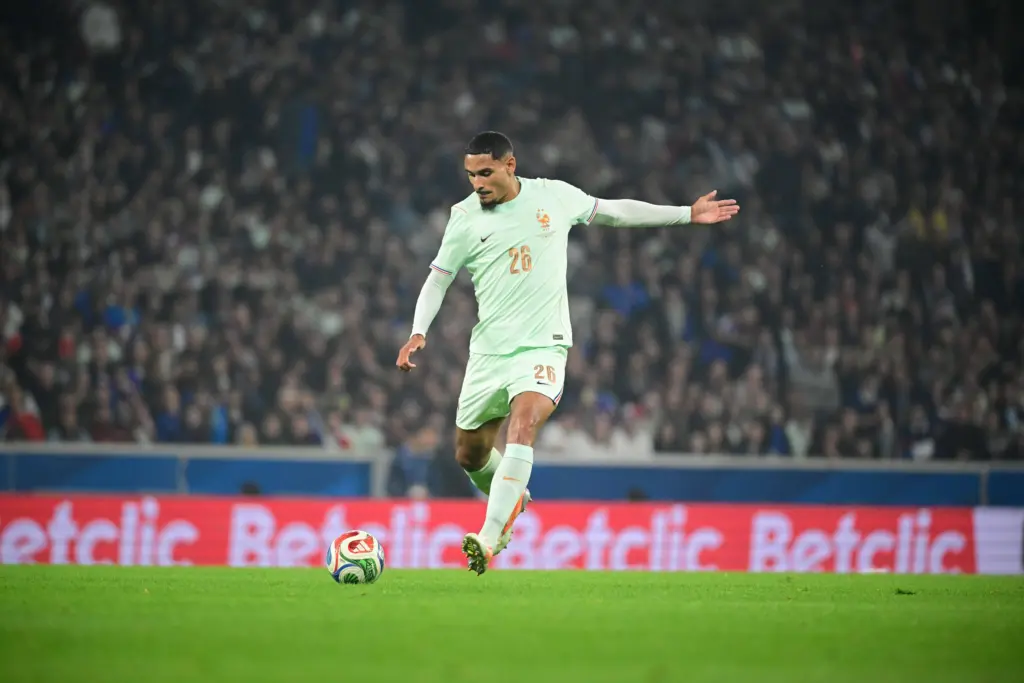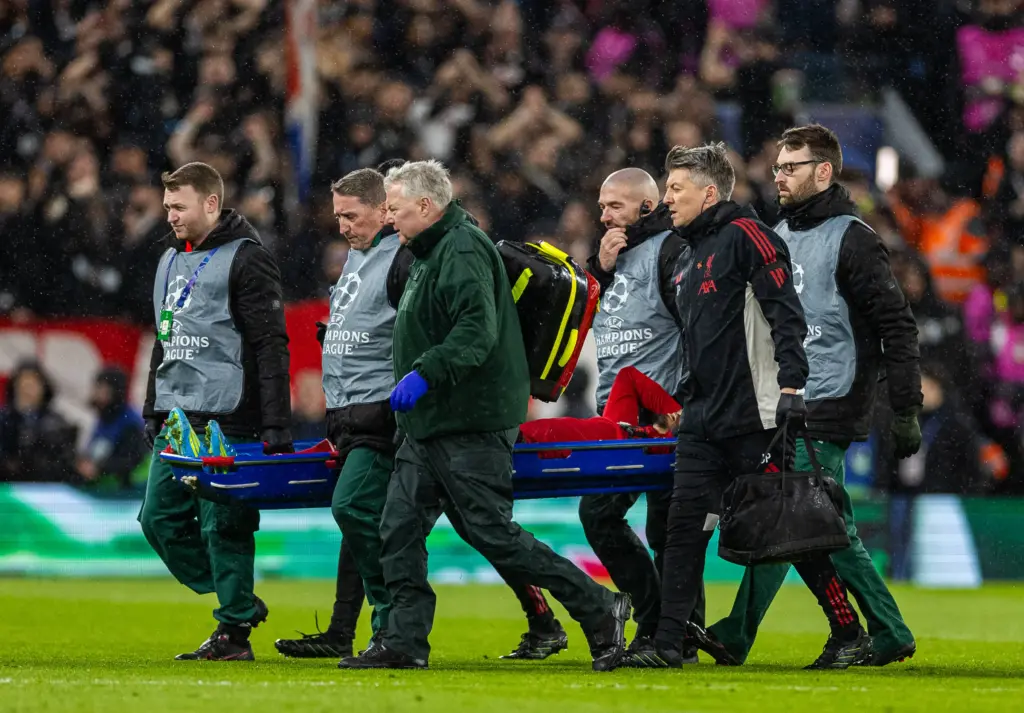

Hugo Ekitic’s injury has been confirmed as a ruptured Achilles tendon, one of the most serious injuries a footballer can suffer.
The injury is often described as a potentially “career-ending” setback and will see the 23-year-old France international sidelined for an extended period of time, with an expected recovery time of eight to nine months.
The devastating rupture of his Achilles tendon means Ekitic will now miss the 2026 World Cup, dealing a huge blow to both his personal and national team ambitions.
The injury occurred during Liverpool’s 2-0 loss to Paris Saint-Germain in the Champions League quarter-finals and was confirmed on Wednesday following detailed medical scans.
Ekitek has been one of Liverpool’s standout performers this season, scoring an impressive 15 goals in 28 Premier League games since moving from German club Eintracht Frankfurt.
His absence now leaves a clear gap in Liverpool’s attack and the trajectory of a player who has been building real momentum this season.
The science behind Hugo Ekitic’s injury: How torn Achilles affects elite football players
The Achilles tendon is the thickest and strongest tendon in the body and is the primary bridge between the powerful calf muscles and the foot.
For football players, it acts like a high-performance “biological spring” that is critical to nearly every action on the pitch, from sprinting to jumping to shooting.
It is responsible for 90% of the calf’s strength. For a forward like Ekitek, it’s the engine that accelerates the “first step” used to beat defenders.
The Achilles tendon helps players accelerate explosively, transferring the force of the calf muscles to the calcaneus to propel the player forward. In sprinting, it can contribute more than 75% of the total positive energy.
During high-speed sprints, the tendon must withstand forces up to 12 times the athlete’s body weight, as well as sudden changes in direction (such as lunging for a tackle), and the Achilles tendon plays a vital role in controlling eccentric forces. It allows athletes to decelerate and rotate efficiently, reducing stress on the knees and hips.
For goalie saves, it absorbs energy during the downward phase of the jump and releases it during takeoff to maximize height. This shows how important the Achilles tendon is to a football player’s overall performance and body stability.
ESPN’s French reporter Julien Laurens quoted a source close to the player as saying the gravity of the moment was clear: “He heard the sound of his Achilles tendon rupturing and then fell to the floor in pain.”
This “pop” is a strong indication of a possible Grade 3 Achilles tendon rupture – the most severe form of injury.
His French teammate Presnel Kimpembe had the same problem, requiring surgery to repair a torn tendon and missing more than 600 days and more than a year.
Ekitic was then carried off the pitch on a stretcher looking visibly distressed and in tears as he left Anfield – a scene that underlined the devastating nature of the injury.
You may also like: PSG knockout stage dominance: Why Liverpool vs PSG prove their strong evolution after league stage
Hugo Ekitic’s injury: a big blow to his season and 2026 World Cup dreams
Like many players before him, Hugo Ekitic’s injury abruptly ended his season, keeping him out of all competitions for almost a year.
The timing couldn’t be worse for the 23-year-old – which also spells the end of his 2026 World Cup dreams, a reality confirmed by France coach Didier Deschamps.
While basic recovery is likely to take around six months, the demands of elite-level football will extend this significantly. In most cases, it takes between nine and 12 months for players to fully recover to ensure the tendons are strong enough to withstand the intense physical stress of top-level football.
Prior to Hugo Ekitic’s injury, the French striker had emerged as Liverpool’s main attacking threat, particularly during Mohamed Salah’s dip in form and Alexander Isak’s injury absence.
His influence in the final third has played a key role in Liverpool’s bid for a top-five spot as they battle to qualify for next season’s Champions League.
Achilles tendon rupture: Can Hugo Ekitic return to top form after injury?
Yes, Ekitek can return to his best form after returning from his Achilles injury, but statistically it won’t be an immediate return as the numbers suggest it could be a multi-season journey rather than a quick comeback.
Despite advances in modern science, injuries remain one of the most challenging issues for explosive athletes.
Studies show that 78% to 82% of professional football players successfully return to play after an Achilles tendon rupture.
However, even after a typical nine-month recovery period, performance indicators (such as goals, assists and minutes played) are often significantly lower than pre-injury levels during the first 12 to 16 months.
Ekitic does have one significant advantage working in his favor: his age.
At 23 years old, he is younger than the average player who suffers this type of injury, which is typically between 27 and 29 years old.
Younger athletes tend to respond better to rehabilitation, increasing the likelihood of recovery with speed and power.
A key factor in his recovery was surgical precision, specifically restoring the tendon’s original length.
Even a little stretching during the repair process can permanently reduce the forward’s “push” power – a key component of acceleration and sharp movements in offense.
Main photo
Credit: imagery / Publicity photos
Recording date: 14.04.2026
PakarPBN
A Private Blog Network (PBN) is a collection of websites that are controlled by a single individual or organization and used primarily to build backlinks to a “money site” in order to influence its ranking in search engines such as Google. The core idea behind a PBN is based on the importance of backlinks in Google’s ranking algorithm. Since Google views backlinks as signals of authority and trust, some website owners attempt to artificially create these signals through a controlled network of sites.
In a typical PBN setup, the owner acquires expired or aged domains that already have existing authority, backlinks, and history. These domains are rebuilt with new content and hosted separately, often using different IP addresses, hosting providers, themes, and ownership details to make them appear unrelated. Within the content published on these sites, links are strategically placed that point to the main website the owner wants to rank higher. By doing this, the owner attempts to pass link equity (also known as “link juice”) from the PBN sites to the target website.
The purpose of a PBN is to give the impression that the target website is naturally earning links from multiple independent sources. If done effectively, this can temporarily improve keyword rankings, increase organic visibility, and drive more traffic from search results.