
Building a championship-winning team is a challenge, but finding players who can make it even stronger is often the difference between a championship and a succession of titles, and Morgan Rodgers to Arsenal could be exactly the kind of move Mikel Arteta makes.
It’s no surprise, then, that Rodgers has remained high on Arsenal’s transfer target list for some time now, with the Gunners now stepping up their pursuit as the England international gets closer to becoming one of their blockbuster signings this summer.
The growing interest reflects Arsenal’s determination to build on their success, with Rodgers seen as a player capable of solving some of the attacking problems they experienced last season despite winning the Premier League title.
For this reason, Arsenal’s pursuit of Morgan Rodgers is about more than just adding another attacking option. It represents Arteta’s ambition to further develop his forward line and it’s worth exploring whether the England international can open up a whole new dimension in Arsenal’s attack.
Morgan Rodgers moves to Arsenal: Why this move feels different to others
Morgan Rodgers is a high transfer target for Arsenal, proving how highly the Gunners value his qualities and why they are prepared to invest heavily in him, making this transfer feel different to many of their recent pursuits.
With Leandro Trossard leaving Arsenal to join Besiktas, there was a major void in attack, which necessitated another quality option and was one of the main factors behind Morgan Rodgers’ move.
Rodgers enjoyed a remarkable 2025/26 season at Aston Villa, helping the club qualify for the Champions League. One of his biggest highlights this season was scoring in the Europa League final against Freiburg, followed by an impressive performance at the ongoing 2026 World Cup, further cementing his status as Arsenal’s transfer target.
What’s particularly attractive about him is that he has a different profile to Arsenal’s current crop of attackers. He is more direct, more physical and has an excellent eye for goal.
His versatility on the front line is another big asset, while he’s already a mature player capable of making an immediate impact without needing years of adaptation.
These qualities explain why momentum continues to build for Morgan Rodgers’ move to Arsenal, and why Arteta sees him as a player who can make an immediate impact.
Arsenal attack Rodgers’ void to fill
The possibility of a move to Arsenal becomes more understandable as Morgan Rodgers irons out his attacking issues in Mikel Arteta’s side.
Despite winning the Premier League title and reaching the Champions League final last season, Arsenal have still had some flaws in attack throughout the season.
There was a clear over-reliance on key players, with Bukayo Saka and Martin Odegaard shouldering much of the creative and goal-scoring responsibilities. Whenever opponents manage to limit their influence, Arsenal’s attack often struggles to maintain the same level of threat.
There is also predictability in the build-up of the attack, particularly in the face of deep defensive blocks and aggressive high pressing, with the Gunners often struggling to break down organized defenses without relying heavily on set-pieces.
The transfer of Morgan Rodgers directly addresses these concerns. He scores goals in different areas of the pitch and is a consistent offensive contributor, scoring 25 goals in all competitions last season.
He also brings a greater physical presence than Arsenal’s current crop of wide players, adding another important dimension to the attack.
His passing and dribbling abilities are equally impressive, as he has the strength and dribbling ability to break through pressure, beat defenders and quickly push Arsenal into dangerous attacking positions.
For this reason, a move for Morgan Rodgers to Arsenal could address some of Arsenal’s attacking deficiencies and potentially take the Gunners to another level.
More than just a winger: The many roles Rodgers can play
Rodgers’ versatility in multiple attacking positions is one of his outstanding qualities that makes him unique among modern forwards, and another reason why he remains high among Arsenal transfer targets.
He can operate effectively as a left winger, cutting inside with his stronger right foot while linking up with overlapping full-backs, a role in which he has scored several outstanding goals.
He is equally at home on the right wing, whether providing natural width or as an inverted attacker who can link up with Bukayo Saka to create balance between the wings.
He can also operate as an attacking midfielder in the No. 10 position, dropping into deeper areas to link the midfield with the attack before making clever runs behind the box.
Another valuable option is to play as a second striker or false nine, who can control the ball, create space for teammates and get into dangerous scoring positions.
The transfer of Morgan Rodgers has brought significant tactical flexibility to Arteta, allowing Arsenal to switch seamlessly between 4-3-3, 4-2-3-1 or even more fluid attacking structures.
His ability to overload the midfield, switch games quickly and adapt to different tactical needs also provides Arteta with greater flexibility in the game, with Rodgers able to change positions according to the state of the game while maintaining a strong chemistry with other attackers.
Overall, Rodgers’ versatility provides greater squad depth and rotation without sacrificing quality, while making Arsenal more unpredictable in their opponents’ preparations.
You may also like: Messi vs. Maradona: Five incredible reasons why Messi’s legacy now trumps Maradona’s
Detail of the painting of Diego Armando Maradona and Lonel Messi during the match between Cruz Azul and Inter Miami at the DRV PNK Stadium on July 21, 2023, equivalent to the 2023 League Cup group stage. Fort Lauderdale, Florida United States Copyright: xDavidxLeahx 20230721171131_LC_23_CAZ_MIA_MESSI7
How Rodgers changed Arsenal’s attacking style
Morgan Rodgers’ move to Arsenal has the potential to strengthen Arsenal’s attacking structure and open up a new attacking dimension under Arteta.
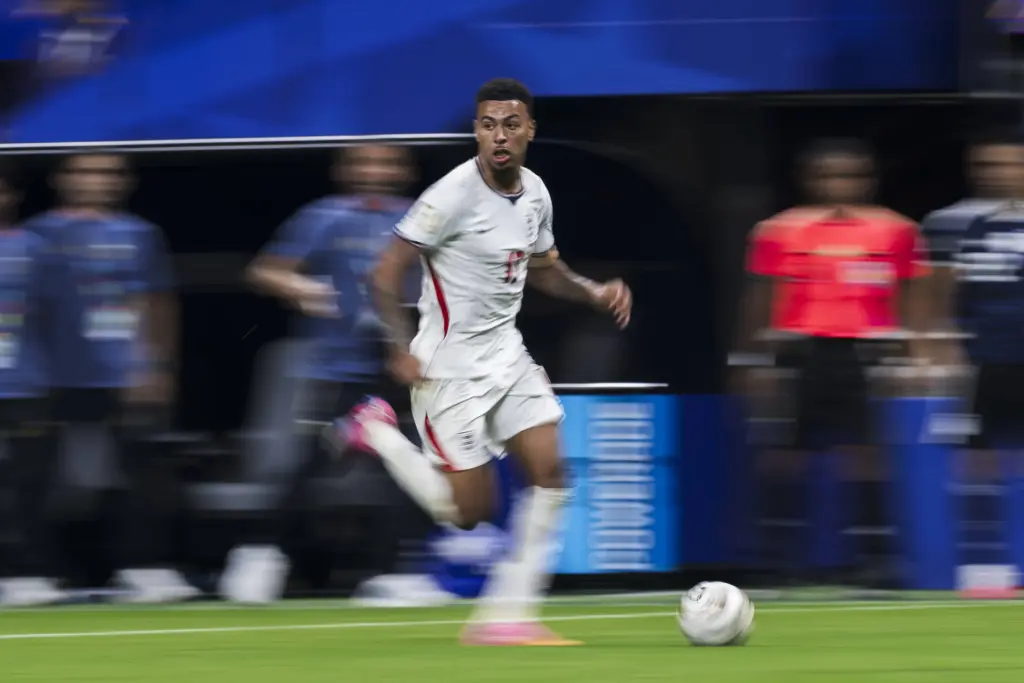
Rodgers would immediately improve Arsenal’s transition speed as he is able to recover possession high up the pitch and then run straight at defenders, allowing the Gunners to switch from defense to attack much quicker than many of their current options.
He also brings excellent progressive dribbling from a deeper position or in the half-space, possesses the dribbling ability to break through first line pressure and carries the ball into the final third with the directness Arsenal occasionally lack.
Against low defenses, Rodgers provides another solution through his physicality and excellent one-on-one ability, using powerful movement to disrupt tight defenses while dragging defenders out of position.
He can also turn Arsenal into a more threatening counter-attacking team through his combination of pace, power and direct movement, while possessing the vision to unleash his teammates at the right moment.
Most importantly, the transfer of Morgan Rogers has improved the fluidity of Arsenal’s overall offense, creating more space for players such as Bukayo Saka and Martin Odegaard through intelligent movement, clever series and combinations in small spaces.
May affect Arsenal’s next signing
Morgan Rodgers’ move to Arsenal has the potential to be much more than just another addition to the squad; it’s a signing that could take Arsenal’s attack to another level.
He is already a proven Premier League player with experience of competing for major honours, and his profile perfectly fits the type of dynamic, versatile and high-octane attacker Arteta wants in his evolving squad.
Viewed from this perspective, Morgan Rodgers’ transfer could become one of Arsenal’s most important transactions of the summer. His arrival will add greater unpredictability, attacking versatility and tactical flexibility, qualities that could prove decisive as the Gunners look to defend their Premier League title and ultimately conquer Europe.
PakarPBN
A Private Blog Network (PBN) is a collection of websites that are controlled by a single individual or organization and used primarily to build backlinks to a “money site” in order to influence its ranking in search engines such as Google. The core idea behind a PBN is based on the importance of backlinks in Google’s ranking algorithm. Since Google views backlinks as signals of authority and trust, some website owners attempt to artificially create these signals through a controlled network of sites.
In a typical PBN setup, the owner acquires expired or aged domains that already have existing authority, backlinks, and history. These domains are rebuilt with new content and hosted separately, often using different IP addresses, hosting providers, themes, and ownership details to make them appear unrelated. Within the content published on these sites, links are strategically placed that point to the main website the owner wants to rank higher. By doing this, the owner attempts to pass link equity (also known as “link juice”) from the PBN sites to the target website.
The purpose of a PBN is to give the impression that the target website is naturally earning links from multiple independent sources. If done effectively, this can temporarily improve keyword rankings, increase organic visibility, and drive more traffic from search results.