
Conjugation of Poder in Portuguese
What can you do? Can you speak Japanese? Portuguese? Or maybe Spanish…? Can you play the guitar? Or any instrument at all? Can you sing? Can you walk from the mall to your house?
Did you notice that these questions all used the same verb? To say the same thing in Portuguese, you would use the verb: poder. Can in Portuguese can have many meanings: ability, permission or possibility.
But before we look at its uses, lets check out the poder conjugation in Portuguese! This is an extremely irregular verb, meaning there are some variations of how it is spelled in different conjugations, so extra attention is demanded here! All the irregular forms will have an asterisk, while the regular ones will be in bold. Remember that those can vary according to whether the verb ends in -AR, -ER, or -IR. Let’s take a look at the poder Portuguese conjugations:
Indicative
| Present | Simple Past | Imperfect Past |
| Eu posso* | Eu pude* | Eu podia |
| Você pode | Você pôde* | Você podia |
| Ele/ ela pode | Ele/ ela pôde* | Ele/ ela podia |
| Nós podemos | Nós pudemos* | Nós podíamos |
| Vocês podem | Vocês puderam* | Vocês podiam |
| Eles/ elas podem | Eles/ elas puderam* | Eles/ elas podiam |
| Past pluperfect simple | Past pluperfect composed |
| Eu pudera* | Eu tinha podido |
| Você pudera* | Você tinha podido |
| Ele/ ela pudera* | Ele/ ela tinha podido |
| Nós pudéramos* | Nós tínhamos podido |
| Vocês puderam* | Vocês tinham podido |
| Eles/ elas puderam* | Eles/ elas tinham podido |
| Simple Future | Immediate Future | Future of the past |
| Eu poderei | Eu vou poder | Eu poderia |
| Você poderá | Você vai poder | Você poderia |
| Ele/ ela poderá | Ele/ ela vai poder | Ele/ ela poderia |
| Nós poderemos | Nós vamos poder | Nós poderíamos |
| Vocês poderão | Vocês vão poder | Vocês poderiam |
| Eles/ elas poderão | Eles/ elas vão poder | Eles/ elas poderiam |
Imperative
| Affirmative | Negative |
| Possa você* | Não possa você |
| Possa ele/ ela* | Não possa ele/ ela |
| Possamos nós* | Não possamos nós |
| Possam vocês* | Não possam vocês |
| Possam eles/ elas* | Não possam eles/ elas |
Subjunctive
| Present | Imperfect Past | Future |
| Que eu possa* | Se eu pudesse* | Quando eu puder* |
| Que você possa* | Se você pudesse* | Quando você puder* |
| Que ele/ ela possa* | Se ele/ela pudesse* | Quando ele/ela puder* |
| Que nós possamos* | Se nós pudéssemos* | Quando nós pudermos* |
| Que vocês possam* | Se vocês pudessem* | Quando vocês puderem* |
| Que eles/ elas possam* | Se eles/elas pudessem* | Quando eles/elas puderem* |
Other tenses
| Personal infinitive | Gerund | Participle |
| Para poder eu | Podendo | Podido |
| Para poder você | ||
| Para poder ele/ ela | ||
| Para podermos nós | ||
| Para poderem vocês | ||
| Para poderem eles/ elas |
How to use Poder in Portuguese?

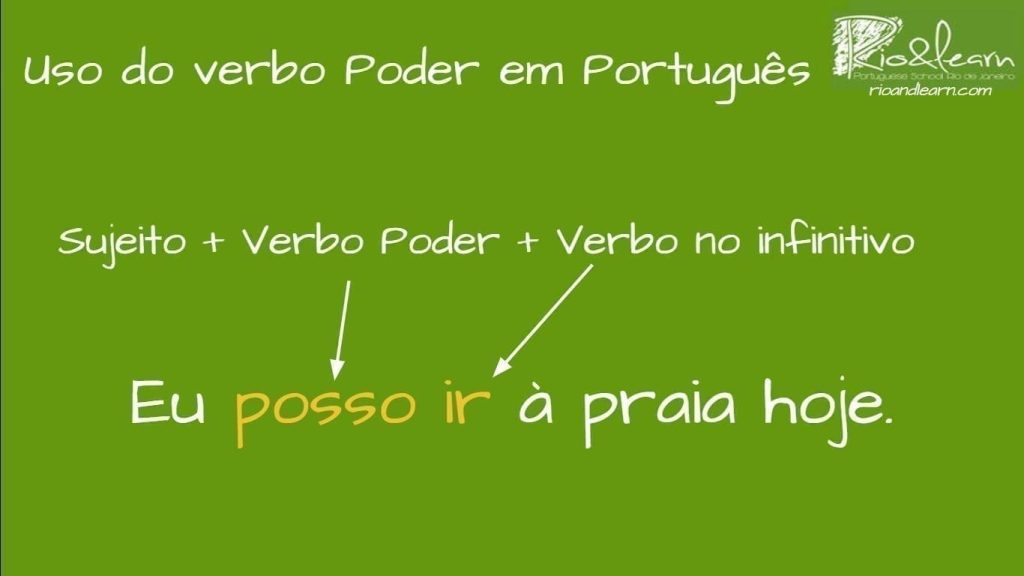
Notice that every time that you use the verb poder in Portuguese you must use a verb in the infinitive form after it. Want to master all of the meanings? Let’s learn them one by one:
Poder in Portuguese for Ability

We use the verb can in Portuguese to talk about abilities: the languages that you can speak, the instruments you can play, awesome things that can you do. In other words, the abilities that you have (or don’t have hahaha). Usually in this case, we use the conjugation of poder in Portuguese in the present or in the imperfect past tense to express abilities that we have or had.
Examples
Claudia pode falar 5 idiomas.
Claudia can speak 5 languages.
Quando criança, Tony podia andar de bicicleta, agora não pode mais.
When he was a child, Tony could ride a bike, now he can’t anymore.
Eu posso aprender português em 30 dias!
I can learn Portuguese in 30 days!
Poder for permission

We can also use the verb can in Portuguese to talk about permission. So, if you are allowed or not to do something, if you need someone’s permission. The best way to talk about this is by using the present poder in Portuguese or the future of the past (poderia). It’s very common to use poderia to be more formal when we are asking for permission.
Examples
Você poderia sair comigo hoje?
Can you go on a date with me today?
Com o visto brasileiro de estudante, você pode ficar aqui por mais tempo.
With the Brazilian student visa, you can stay here for more time.
Eles não podem viajar, porque trabalham a semana toda.
They can’t travel, because they work all week.
Poder for possibility

Finally, we can use the verb poder to talk about possibilities too. When you’re not sure if something will happen, but you know it might. To talk about possibilities we generally use the present or the future tenses.
Examples
Pode ser que faça sol hoje à tarde.
It might be sunny this afternoon.
Se você quiser, eu posso te ajudar.
If you want, I can help you.
Ela poderá visitar o Cristo quando for ao Rio.
She could visit Cristo when she goes to Rio.
Poder as a noun
The word poder in Portuguese can also be a noun, instead of a verb. Poder means power, a strength that someone has. Do you know the X men? They would be regular people if it wasn’t for their poderes.
FAQ about the verb poder in Portuguese
What’s the difference between “poder” and “conseguir” in Portuguese?
Poder indicates permission, possibility, or general ability, while conseguir emphasizes the result of an effort — the idea of having succeeded at something. For example, “eu posso nadar” (I can swim) talks about the ability itself, while “eu consegui nadar até a boia” (I managed to swim to the buoy) talks about the result achieved in that specific moment.
When do you use “poderia” instead of “posso”?
Poderia (future of the past / conditional) is used for more polite, formal requests, like “Você poderia me ajudar?” (Could you help me?), while posso (present) is more direct and informal, like “Posso te ajudar?” (Can I help you?). Both are understood, but poderia sounds more courteous.
Does the meaning of “poder” change depending on the tense?
Partly, yes: the present and the conditional (poderia) are used for ability, permission, and possibility alike, but the imperfect past (podia) is mainly used to talk about abilities or permissions you had in the past and no longer have.
Can “poder” be used as a noun in Portuguese?
Yes. Besides being a verb, poder is also a noun meaning power, authority, or the capacity to control something — as in “o poder de um super-herói” (a superhero’s power) or “o poder do presidente” (the president’s power).
Portuguese Conjugation of Poder Exercise
Complete the sentences using the conjugation of poder in Portuguese. Read the sentences carefully because you have to choose the person and the tense of the verb correctly.
- Será que vocês ______ acertar estes exercícios?
- Se eu _______ voar, viajaria o mundo todo.
- Em 2020 ela ________ viajar para Itália.
- Nós queríamos estudar português no Brasil, mas não _________.
- Quando eu era jovem, eu _______ beber muito e não tinha ressaca.
- Agora eles não _____ almoçar. Só _____ _______ às 14:00.
- O que você faria se _______ fazer tudo?
- Desejo que vocês _______ voltar mais vezes ao Brasil.
- Talvez ele _______ comprar uma casa.
- Ontem ele não ______ surfar, porque o mar estava bravo.
- Sempre que quiser, você ______ voltar.
- Faço tudo o que ______ para te ver feliz.
- Elas _______ ficar juntas logo, né? Não aguento mais enrolação…
- Quando nós __________, faremos uma festa.
- Eu não ______ voar de avião. Tenho medo de altura.
Alright?
Now you know lots of different ways to use the verb poder in Portuguese. Therefore you can use it properly, right?
So tell us what you can do in Brazil and can’t do in your country? What could you do as child? And what can’t you do anymore as an adult?
We at Rio & Learn hope you enjoyed this Dica and got all the questions right!
A big hug for you all!
See you!


Click in the links below to see more related Dicas
Simple present of verb Poder in Portuguese
Conseguir and Poder in Portuguese
Formas polidas
Asking for favors in Portuguese
Portuguese Conjugation of Poder answers:
- Será que vocês podem acertar estes exercícios?
- Se eu pudesse voar, viajaria o mundo todo.
- Em 2020 ela poderá viajar para Itália.
- Nós queríamos estudar português no Brasil, mas não pudemos.
- Quando eu era jovem, eu podia beber muito e não tinha ressaca.
- Agora eles não podem almoçar. Só vão poder às 14:00.
- O que você faria se pudesse fazer tudo?
- Desejo que vocês possam voltar mais vezes ao Brasil.
- Talvez ele possa comprar uma casa.
- Ontem ele não pôde surfar, porque o mar estava bravo.
- Sempre que quiser, você poderá voltar.
- Faço tudo o que puder para te ver feliz.
- Elas podem ficar juntas logo, né? Não aguento mais enrolação…
- Quando nós pudermos, faremos uma festa.
- Eu não posso voar de avião. Tenho medo de altura.

Online Academic Coordinator at Rio & Learn Portuguese School.
Experienced educational coordinator and teacher since 2007, adept in curriculum development, creating physical and digital educational materials, and leveraging online platforms to enhance learning outcomes
PakarPBN
A Private Blog Network (PBN) is a collection of websites that are controlled by a single individual or organization and used primarily to build backlinks to a “money site” in order to influence its ranking in search engines such as Google. The core idea behind a PBN is based on the importance of backlinks in Google’s ranking algorithm. Since Google views backlinks as signals of authority and trust, some website owners attempt to artificially create these signals through a controlled network of sites.
In a typical PBN setup, the owner acquires expired or aged domains that already have existing authority, backlinks, and history. These domains are rebuilt with new content and hosted separately, often using different IP addresses, hosting providers, themes, and ownership details to make them appear unrelated. Within the content published on these sites, links are strategically placed that point to the main website the owner wants to rank higher. By doing this, the owner attempts to pass link equity (also known as “link juice”) from the PBN sites to the target website.
The purpose of a PBN is to give the impression that the target website is naturally earning links from multiple independent sources. If done effectively, this can temporarily improve keyword rankings, increase organic visibility, and drive more traffic from search results.
Streaming Film
Nonton Film gratis
Jasa Backlink
Download Anime Batch